
Every rupee of that trade now moves outside the law. The Prohibition of Electronic Cigarettes Act (PECA), 2019 was meant to stop a vaping market from taking root in India. It failed. What it did do was strip away the age checks, safety standards and taxes that come with a legal market.
So the debate over India’s vape ban needs a reset. Indians vape. The real question is whether the government or the black market runs the trade.
India’s vape market is growing almost as fast as the world’s
IMARC Group’s latest report puts the growth of India’s e-cigarette market at 4.46% a year to 2034, taking it from USD 2.41 billion in 2026 to USD 3.41 billion. Measured the same way, IMARC puts growth in the global e-cigarette market, where vapes are legal in most big countries, at 5.44%. On a like-for-like basis, a banned market is growing within a percentage point of a largely legal one.
Government data points the same way. The Directorate of Revenue Intelligence seized about 8 lakh e-cigarettes in 2024-25, up from about 11,000 in 2021-22. Enforcement agencies don’t seize 70 times more stock from a market that is shrinking.
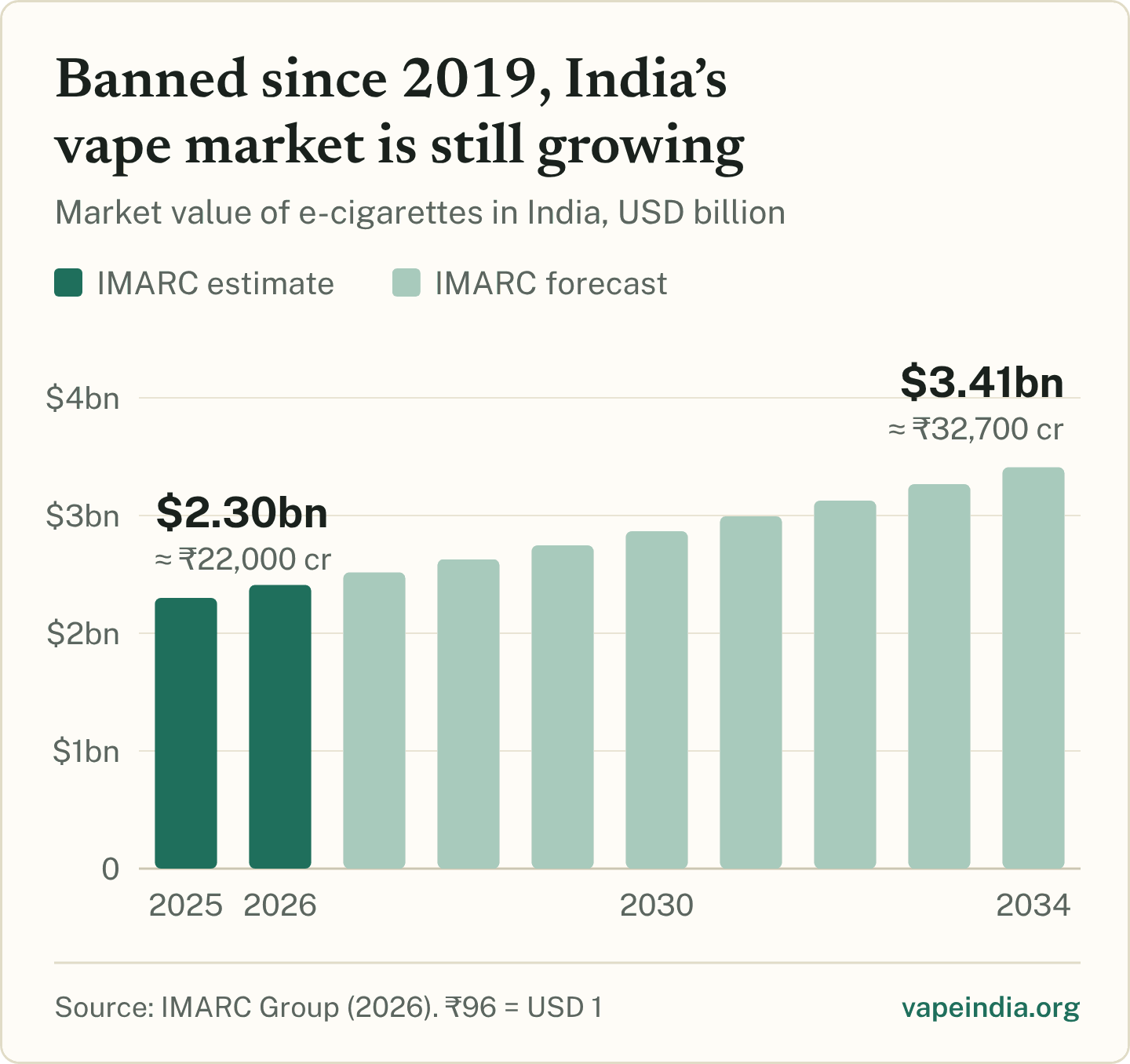 Source: IMARC Group, India E-Cigarette Market Report 2026-2034. Years 2027 to 2033 follow IMARC’s forecast growth rate.
Meanwhile India’s legal cigarette market, worth USD 29.22 billion in 2025, is forecast to grow 9.5% a year. The ban has done nothing to slow the deadliest way to use nicotine. It has only driven a far safer one underground.
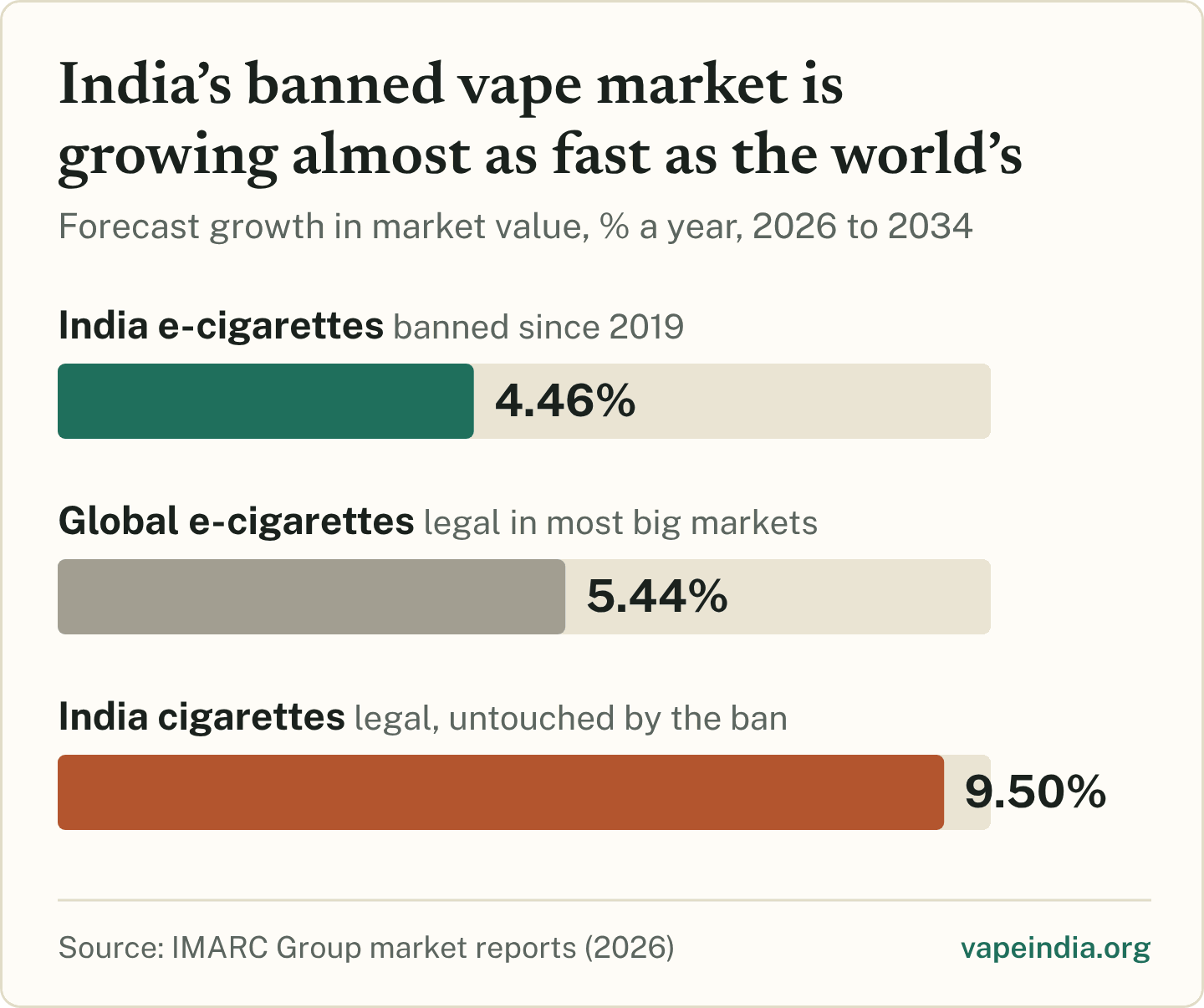 Source: IMARC Group market reports for India e-cigarettes, global e-cigarettes and India cigarettes, 2026.
How does a banned market keep growing? Largely online. IMARC estimates that 36% of sales happen online, and its report counts 83 online stores selling e-cigarettes into India, 49 of them Indian. Even IMARC’s analysts conclude that the ban “paradoxically undermines policy objectives” by stripping away the oversight that could keep vapes safe and out of young hands.
Why vaping demand in India refuses to fall
Most vapers in India are smokers looking for something less harmful. A survey of 3,000 vapers in eight Indian cities, published in 2020, found that 80% first used nicotine by smoking or chewing tobacco. Some 79% believed vaping is less harmful than smoking, and among the smokers, 30% had quit and another 41% had cut down.
They’re right. Cancer Research UK says regulated e-cigarettes are far less harmful than smoking, and the 2025 Cochrane review, the gold standard of medical evidence, found with high certainty that nicotine e-cigarettes help more smokers quit than nicotine patches or gum. People who switched and felt the difference won’t go back to cigarettes because of a ban.
Nor do they struggle to find supply. A 2023 study led by Simone Pettigrew of 840 college-educated young adults found 23% had tried vaping, and that users got vapes from shops, tobacconists and friends despite a complete ban.
The people most likely to get the risk wrong are older smokers, who have the most to gain from switching. In the US, smokers aged 55 to 64 had 71% higher odds than those aged 18 to 24 of rating vapes as more harmful than cigarettes. In England, smokers over 65 were less sure of the relative harms and less likely to use vapes to quit, though the evidence shows vapes help them quit too. India’s ban hits this group twice. Older smokers have no regulated alternative to switch to, and years of official messaging tell them vaping is no safer anyway.
Vaping in India is highest where smoking is highest
North India is the country’s biggest e-cigarette market, with 30% of national sales. It is also the heartland of smoking, with 34% of the legal cigarette market. And while tobacco users in western and central India mostly chew, men in the north who use tobacco mostly smoke it.
Vaping clusters where cigarette smoking clusters. That’s the pattern you’d expect if e-cigarettes are replacing cigarettes rather than recruiting new users, and IMARC itself credits the north’s lead partly to smokers switching from cigarettes. Tobacco is also the largest flavour segment, at 35% of sales, the natural choice for a smoker making the switch.
Youth vaping in India: a ban with no age checks
PECA was sold as a law to protect children. It ended up removing every guardrail that could have done that. An illegal seller has no licence to lose, so nobody checks age. Nothing caps nicotine strength, and nobody requires warning labels or child-resistant packaging.
Schools are feeling it. Focus groups with 72 students in Mumbai’s municipal schools found that vapes reach them with ease despite the ban. A Think Change Forum survey of 1,007 students aged 14 to 17 in six cities found 96% didn’t know vapes were banned, and only 11% thought they were harmful. When the official line is that vapes don’t exist in India, nobody teaches teenagers about them.
Countries that regulate have done far better. After teen vaping spiked in 2019, the US raised the minimum age to 21, stepped up enforcement and ran education campaigns such as the FDA’s The Real Cost. Youth e-cigarette use fell about 18% a year between 2022 and 2025, and by 2025 just 5.2% of middle and high school students used them. In Great Britain, where adults buy vapes legally, only 4% of 11 to 17 year olds vape regularly, and that figure has stopped rising.
Vape bans around the world: what happened next
India isn’t the only country to try prohibition, and the record is grim.
- Thailand, ban since 2014: e-cigarette users aged 15 and over rose from about 78,000 in 2021 to more than 400,000 in 2024.
- Brazil, ban since 2009: an estimated 5.3 million users, while the value of seized vapes nearly tripled between 2023 and 2024.
- Mexico, constitutional ban since 2025: drug cartels, including the Jalisco New Generation Cartel, have moved into the trade.
- Australia, pharmacy-only sales since 2024: about 96% of vapes sold are illegal.
- Argentina, ban from 2011 to 2026: lifted in May 2026 after the government acknowledged that 35.5% of secondary school students vaped despite it.
Australia is worth a closer look because no country has tried harder. By 2025, 80% of the nicotine Australians consumed came from the black market, up from 12% in 2017, and tobacco excise revenue had halved from its 2019-20 peak.
Argentina shows the way out. After 15 years, its government accepted that prohibition had not worked and set up a registry to regulate vapes, heated tobacco and nicotine pouches. Officials argued that rules would curb smuggling and unsafe devices far better than a ban that existed only on paper.
The tax India loses to the vape black market
Cigarettes are a ₹2.8 lakh crore market in India. Vapes are about 8% of that. But 8% of a giant is still ₹22,000 crore, and it grows every year.
Since February 2026, cigarettes carry 40% GST plus a new excise of ₹2.05 to ₹8.50 a stick, taking total taxes to about 53% of the retail price. Bidis, meanwhile, pay just 18% GST.
Vaping is far less harmful than smoking, so it should be taxed far more lightly. The simplest fix is the standard 18% GST, the same rate as bidis, which works out to about 15% of the retail price. A small excise on each ml of liquid could take that to around 20%, still well under half the cigarette burden. Put vapes in the 40% sin slab instead and the price gap that gets smokers to switch disappears.
Even at those modest rates, a legal market would raise ₹3,500 to 4,600 crore (about $360 to 480 million) in 2026, rising to ₹4,900 to 6,500 crore (about $510 to 680 million) a year by 2034. Over nine years, that adds up to ₹37,000 to 50,000 crore (about $3.9 to 5.2 billion).
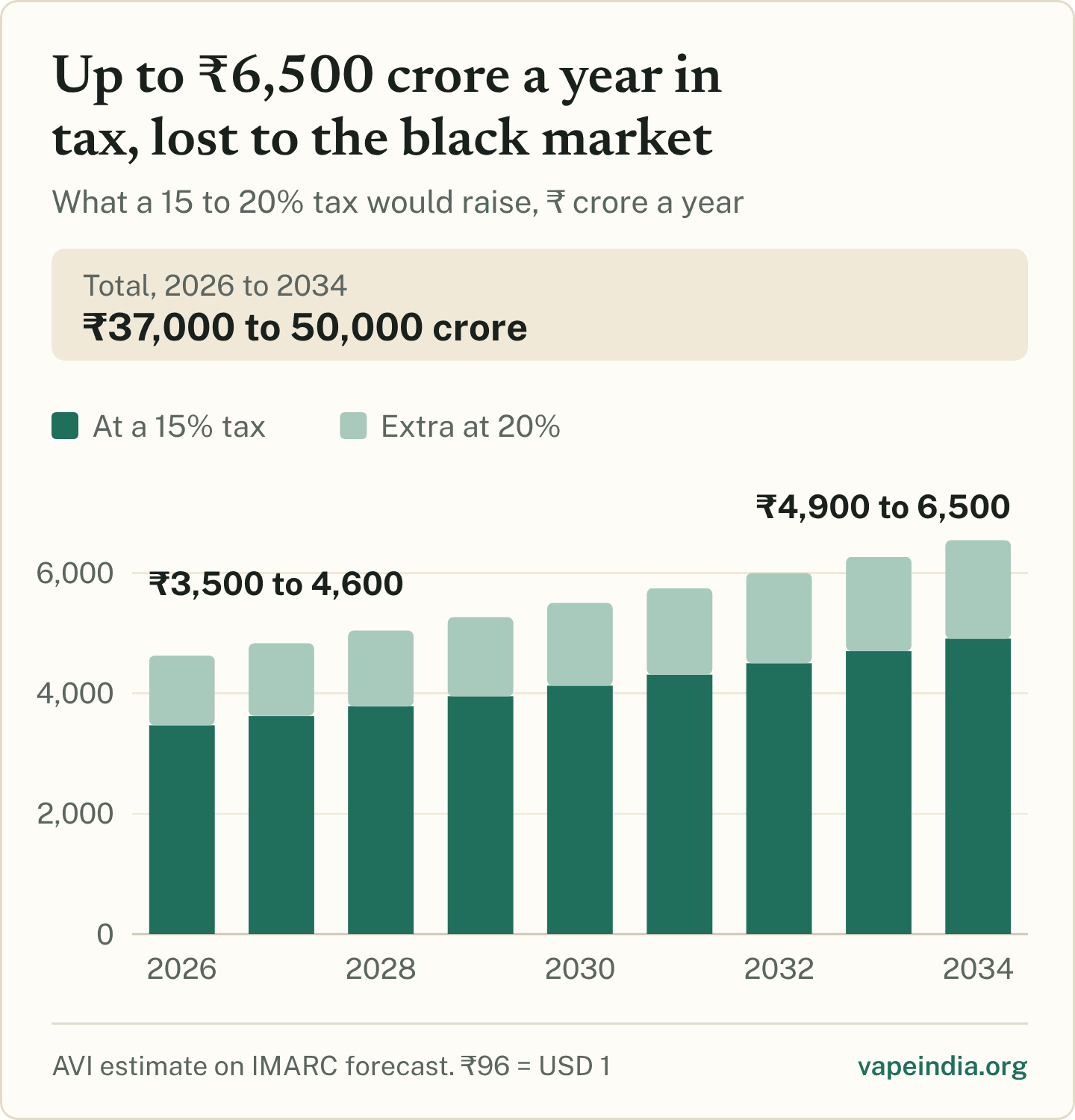 AVI calculation on IMARC Group’s market forecast, at ₹96 to the US dollar.
Today that whole ₹22,000 crore trade enriches smugglers and unlicensed sellers, and the exchequer gets nothing. Australia shows where that leads once an untaxed nicotine trade gets big enough to fight over: its illicit tobacco and vape market has been tied to more than 200 firebombings and at least three killings. In India, the same money could fund quit-smoking services and the kind of awareness campaigns that brought youth vaping down in the US.
A legal market would also speed up switching. Cigarette tax would fall as smokers move across, but that is the point of tobacco control: India already loses ₹1.77 lakh crore a year (about $18.4 billion) to tobacco-related disease and death, far more than any tax it collects.
How India could regulate e-cigarettes instead
The government can keep the ban and watch the black market grow, as Thailand and Brazil have. It can crack down harder, as Thailand has with mass arrests and more than 9,500 blocked websites, and still lose. Or it can follow Argentina and swap prohibition for rules.
A workable vaping law for India would include:
- Licensed sale only, with strict age checks and real penalties for selling to minors
- Safety standards for nicotine strength, ingredients, batteries and child-resistant packaging
- A risk-proportionate tax: 18% GST, with at most a small excise, keeping vapes far cheaper than cigarettes so smokers have a reason to switch
- Track and trace on every legal device and refill, so illegal stock stands out
- Earmarked revenue for youth prevention and for help to quit aimed at older smokers
Yes, some black market will survive under regulation. That’s no argument for a ban. The goal is to shrink illegal trade, and Australia shows illicit sellers thrive when the legal route is too hard or too costly. Make the legal route easy and fairly priced, and most adults have no reason to deal with an unlicensed seller.
Seven years on, PECA has given India the worst of both worlds: a ₹22,000 crore e-cigarette market that keeps growing, with no age checks, no safety standards and no tax. Argentina took 15 years to admit its ban had failed. India shouldn’t wait that long.
Vaping in India: quick answers
Is vaping legal in India?
Selling is banned, using is not. PECA bans making, importing, exporting, selling, distributing and advertising e-cigarettes, and storing or transporting them for sale, with up to a year in jail and a ₹1 lakh fine for a first offence. No provision in PECA makes personal use or possession an offence. More on the law.
How big is the e-cigarette market in India?
About USD 2.30 billion, or roughly ₹22,000 crore, in 2025, according to IMARC Group. IMARC forecasts growth of 4.46% a year, taking the market to USD 3.41 billion by 2034.
Has the vape ban reduced vaping in India?
No. E-cigarettes are still sold online, by tobacconists and through informal networks, and the market keeps growing. North India is the largest regional market, with 30% of sales.
How much tax does India lose because of the vape ban?
By AVI’s estimate, a 15 to 20% tax on a legal market would raise ₹3,500 to 4,600 crore in 2026 and up to ₹6,500 crore a year by 2034, or ₹37,000 to 50,000 crore over nine years.
Are e-cigarettes safer than cigarettes?
Yes. Vapes don’t burn tobacco, the source of most smoking harm, and Cancer Research UK says regulated e-cigarettes are far less harmful than smoking. The 2025 Cochrane review found high-certainty evidence that nicotine e-cigarettes help more smokers quit than nicotine replacement therapy.
Which countries have lifted vape bans or moved to regulate?
Argentina ended its 15-year ban in May 2026 and now regulates e-cigarettes through a national registry. Paraguay has also chosen regulation over prohibition, with a 2025 law that limits sales to adults through specialist shops and caps nicotine strength.
Related analysis: No, Prof Srinath Reddy, Nicotine is Not the Killer.