
On 23 October, the New Indian Express carried a column by Prof K Srinath Reddy titled Kicking the butt alone won’t do it. Prof Reddy is one of India’s most respected public health voices, and his work on heart disease and tobacco control has shaped policy for decades.
His standing is the reason the column deserves a careful reply. It argues that nicotine itself, along with tobacco, should be the target of regulation. And it supports that case with claims that don’t hold up against the evidence, including evidence published by India’s own health ministry.
Some of it we agree with. Duty-free shops at Indian airports should follow Indian law, and the Bombay High Court was entitled to say so. The trouble starts when the column moves from jurisdiction to pharmacology.
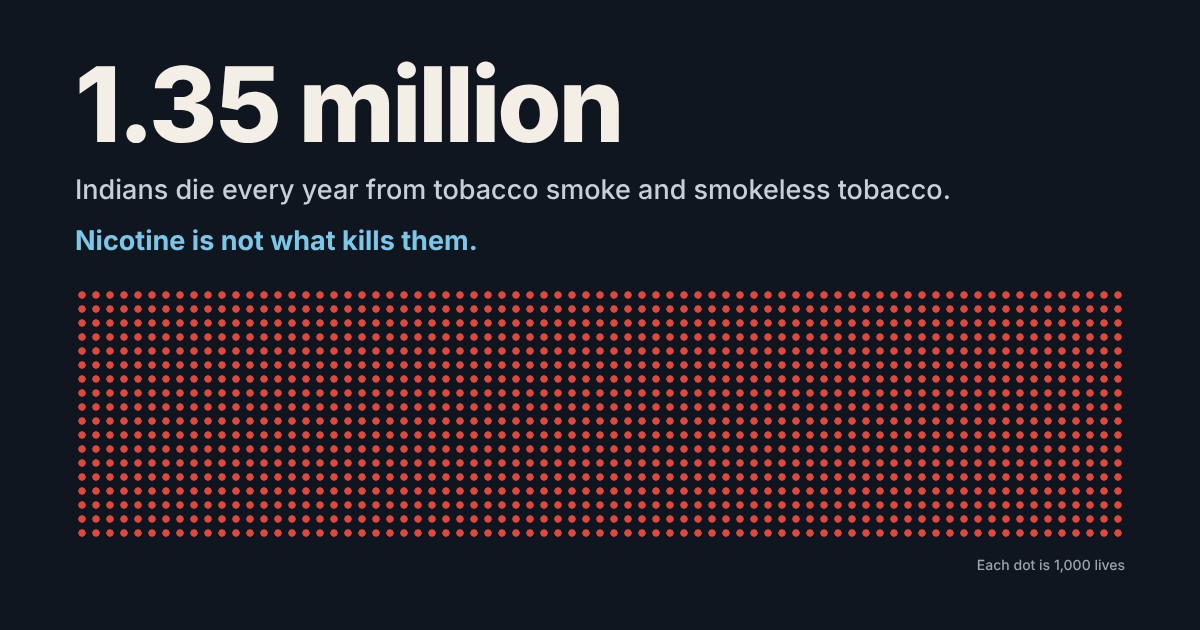
We take his arguments in turn below. Our purpose is to keep India’s tobacco policy focused on what kills 1.35 million Indians a year: smoked and smokeless tobacco.
AVI is a consumer advocacy group. We take no funding from the tobacco or pharmaceutical industries.
Addiction, hazard and risk are separate questions
The column treats everything nicotine does as a single problem. In its telling, nicotine is addictive, so it must be dangerous; it’s in vapes, so vapes must be as bad as cigarettes; and it comes in strong doses in pouches, so pouches must be a threat.
Veteran US tobacco control advocate Cliff Douglas calls this a recurring conceptual error. He separates three ideas that the column blends together:
- Addictiveness is how strongly a product makes you want to keep using it.
- Hazard is whether something is capable of causing harm.
- Risk depends on the dose, the route and how long you’re exposed.
A nicotine patch, a vape, a pouch and a cigarette all deliver nicotine, yet they are far from equal sources of disease. In Douglas’s account, the presence or absence of combustion matters most.
The UK’s medicines regulator made the same point in 2010. Nicotine is strongly addictive, the MHRA noted, while tobacco smoke causes the diseases and early deaths linked to smoking.
We aren’t claiming nicotine is harmless. The useful question is how much harm it causes compared with what smokers and smokeless tobacco users rely on today, and the column never asks it.
WHO has never called nicotine as addictive as heroin
The column states that nicotine is considered “as addictive as heroin and cocaine” by the World Health Organization, the American Psychiatric Association and the US Surgeon General.
That attribution to WHO is wrong. We searched WHO’s assessments, reports and fact sheets and found no finding that equates nicotine with heroin or cocaine. Readers of a national newspaper are entitled to expect a claim this serious to come with a source, and the column offers none.
The comparison has a different origin. The 1988 US Surgeon General’s report concluded that the processes behind tobacco addiction are similar to those behind addiction to heroin and cocaine. That describes how smoking hooks people. It was never a ranking of pure nicotine, and it was written before patches, gum or vapes were in wide use.
The American Psychiatric Association classifies tobacco use disorder in its diagnostic manual. That gives clinicians a diagnosis and makes no claim that nicotine equals heroin.
International drug law points the same way. Heroin and cocaine are controlled under the UN’s 1961 Single Convention on Narcotic Drugs. Nicotine is not, and WHO’s drug dependence committee has only now begun a review of it because Palau requested one in June, as we discuss below.
The comparison also ignores how the product shapes dependence. A cigarette delivers nicotine together with thousands of combustion chemicals, some of which appear to reinforce its effects. A 1996 brain-imaging study in Nature found that smokers had markedly lower levels of MAO-B, an enzyme that breaks down dopamine, and traced the effect to something in smoke other than nicotine. Gums, patches, vapes and pouches carry none of that smoke chemistry. The same molecule, delivered without combustion, is a different proposition, which is why governments sell nicotine over the counter as medicine.
Nicotine has never been classed as a carcinogen
The column argues that nicotine-only products won’t free smokers from cancer risk. It cites what it calls a US National Institutes of Health report on nicotine’s effects on tumour growth and malignancy.
The quoted passages come from a 2015 review by two Norwegian researchers, Tore Sanner and Tom Grimsrud, published in Frontiers in Oncology. It appears on the NIH’s PubMed Central website, which hosts millions of open-access journal papers, but it is a journal review rather than an NIH report.
The review draws on laboratory and animal studies suggesting nicotine may act as a tumour promoter, meaning it could influence the growth of cancers started by other agents. That possibility is acknowledged in the literature and deserves research. It is a long way from showing that nicotine causes cancer in people, and the human evidence points the other way. In the Lung Health Study, which followed more than 3,300 participants for over a decade, NRT use did not predict lung, oral or other cancers. Smoking did.
The authoritative bodies are consistent on this:
- IARC, the WHO’s cancer research agency, has never classified nicotine as a carcinogen, while noting it may enhance the effects of other carcinogens. Tobacco smoke and smokeless tobacco are Group 1 carcinogens. Nicotine isn’t on the list.
- The US Surgeon General found in 2014 that the evidence was inadequate to infer a causal link between nicotine and cancer.
- The US FDA doesn’t list nicotine as a carcinogen among its harmful constituents.
- A 2016 comprehensive review of human and animal studies found the evidence doesn’t support nicotine acting as a carcinogen in its own right.
The column also says cancer-causing nitrosamines “may be formed from nicotine in the body”. Sanner and Grimsrud do discuss this possibility. Their own paper notes, however, that urine from vapers showed very low levels of the relevant marker, which may suggest such formation after inhaling nicotine is negligible.
Set that beside what Indians actually use. Cigarette smoke contains dozens of known carcinogens, and smokeless tobacco is behind nearly 90% of India’s oral cancers. The column’s caution about a theoretical risk from nicotine overlooks the proven and very large risk from the products people would otherwise keep using.
India’s health ministry backs long-term nicotine gum
If nicotine were the killer the column describes, India’s health system would be prescribing poison. It isn’t.
The Ministry of Health and Family Welfare published a Manual for Tobacco Cessation for doctors under the National Cancer Control Programme. Its section on nicotine gum (p. 67) makes three points:
- About 10% to 20% of people who quit smoking with nicotine gum keep using it for nine months or more, though few use it longer than two years.
- Several lines of evidence suggest most long-term use is not dependence.
- Harmful effects of long-term gum use are unlikely, given there’s no exposure to carcinogens or carbon monoxide and nicotine levels are much lower than from cigarettes.
The manual also records that cardiovascular disease, pregnancy and high blood pressure were once listed as reasons not to use nicotine gum. Those contraindications were dropped because nicotine levels from gum are so much lower than from smoking. The same manual draws on a 2004 report on tobacco control in India that Prof Reddy co-authored.
The UK reached the same conclusion. In its 2010 assessment, the MHRA found “a large body of evidence” that licensed medicinal nicotine isn’t a significant risk factor for heart attacks and strokes, and doesn’t cause cancer or lung disease. It went on to approve NRT for long-term use as a safer alternative to smoking.
Clinicians in the US report the same experience. Dr John Hughes of the University of Vermont told WebMD he had seen people use nicotine gum for 15 years without apparent harm. In the same article, Dr Richard Hurt of the Mayo Clinic described the choice between smoking and pure nicotine as “a no-brainer”.
Nicotine replacement products are on WHO’s Model List of Essential Medicines. In India, 2 mg nicotine lozenges have been exempt from the need for a drug sale licence. A molecule judged safe enough for the chemist’s counter can hardly be deadly enough to justify banning it in every other form.
Poison, pesticide and the dose that matters
The column lists a series of alarming facts about nicotine: it is classified as a poison in pharmacology and used as a pesticide in agriculture; it can be lethal in high doses; children who accidentally consumed e-liquid stored at home have died; and it raises heart rate and blood pressure and can precipitate strokes and heart attacks.
Each of these needs context.
On the heart. Nicotine does briefly raise heart rate and blood pressure, as coffee does. The relevant question is whether it causes heart attacks and strokes in the people who use it. A 2014 network meta-analysis of 63 trials in Circulation found that NRT increased minor events such as a racing heart, with no clear evidence of serious events like heart attack, stroke or cardiac death. A 2023 systematic review reached a similar conclusion with moderate certainty. Smoking, by contrast, is one of the leading causes of heart disease worldwide. The column’s claims about sperm and DNA damage cite no studies of people using NRT, vapes or pouches.
On the dose. Calling nicotine a “poison” tells us little, since many medicines on pharmacy shelves are poisonous at the wrong dose. The often-quoted lethal dose of 30 to 60 mg rests on dubious self-experiments from the 1850s, according to toxicologist Bernd Mayer. His review of real poisoning cases put the lower limit of a fatal oral dose for an adult at 500 to 1,000 mg. A cigarette delivers about 2 mg.
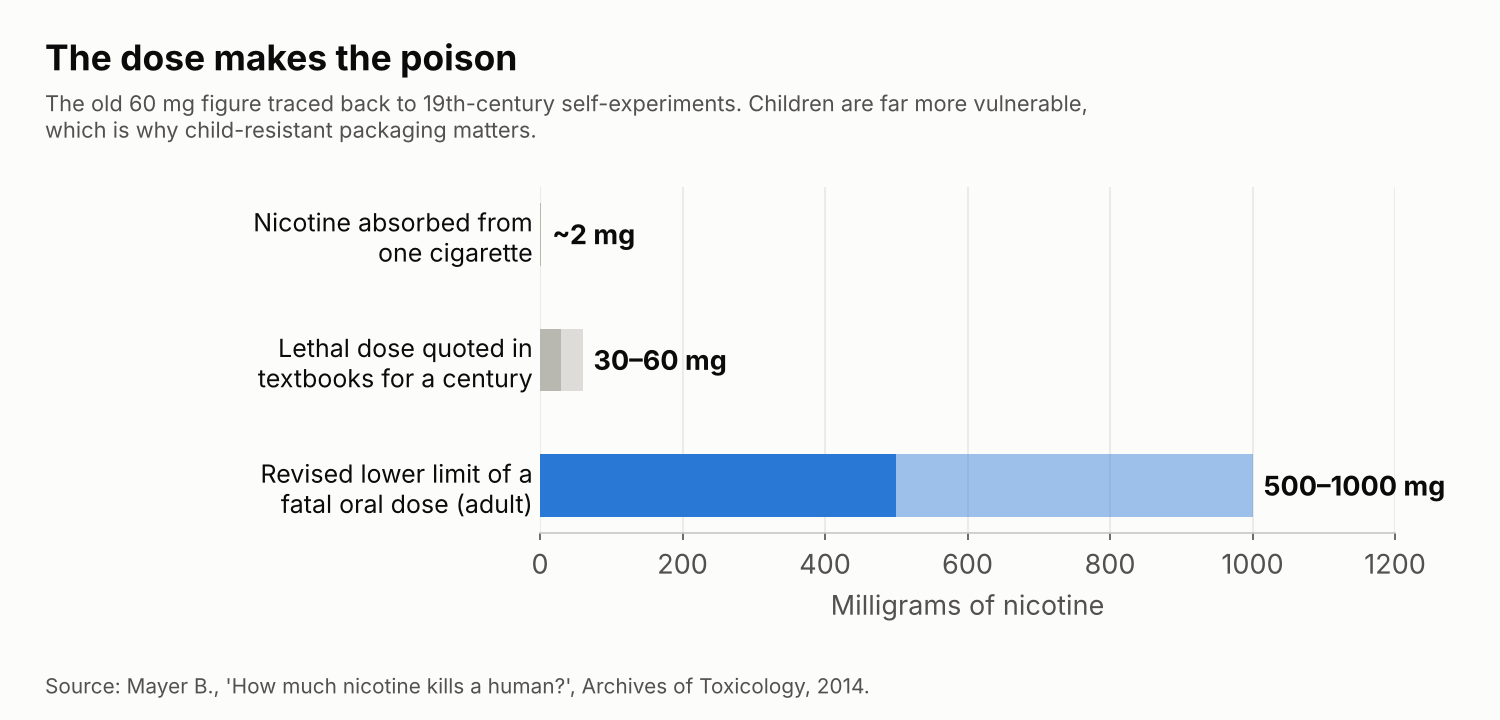 Source: Mayer B., Archives of Toxicology, 2014.
On pesticides. Nicotine, like many plant compounds, has been used as an insecticide, because plants evolved it to deter insects. That tells us nothing about the risk to an adult using a regulated product at a human dose.
On children. Every child’s death from nicotine poisoning is a tragedy, and children are far more sensitive than adults. The proven response is child-resistant packaging, which the US made mandatory for liquid nicotine in 2016. We don’t ban paracetamol or floor cleaner because children can swallow them; we put them in safe packaging and keep them out of reach. India’s vape ban does the opposite, since products now arrive through a black market with no packaging rules at all.
Safer isn’t safe, yet it saves lives
Behind all this lies a simple idea. The writer Alan Gor calls “safer” public health’s most dangerous word.
Safer doesn’t mean safe. Seatbelts don’t make car crashes harmless, clean needles don’t make drug use risk-free and methadone is no vitamin. Public health embraced all of them because they cut harm for people who would otherwise take bigger risks.
Nicotine harm reduction works the same way. A smoker or smokeless tobacco user who switches to a vape or pouch doesn’t reach zero risk, but moves from the most dangerous forms of nicotine use to one that is far less dangerous. In a country with 267 million tobacco users, that difference is measured in lives.
Treating nicotine as the villain turns a health question into a moral one. The aim of public health is to reduce death and disease, and adults who choose a far less harmful way of using nicotine have moved in that direction. Insisting that they either quit nicotine altogether or keep using tobacco is paternalism, and it costs lives.
ICMR’s pouch study says nothing about health risks
The column says that the Indian Council of Medical Research has recently released a report highlighting the health hazards of unregulated nicotine consumption.
We looked for it. The recent ICMR work on this subject comes from the ICMR-National Institute of Cancer Prevention and Research, and its focus is availability. A 2026 survey found nicotine pouches on sale in seven of 10 cities and at about 9% of tobacco shops, and raised concerns about online sales and enforcement. A related ICMR-NICPR consultation report dealt with legal status and import controls.
That’s useful information for regulators. Neither document adds new evidence that nicotine pouches harm health. If there’s a separate ICMR report on health hazards, we would welcome a link to it.
The availability data also carries its own lesson. People are seeking out these products despite the absence of a legal market. As with vapes, prohibition hasn’t stopped demand; it has only removed age checks and quality standards.
Nicotine strength is not a marker of harm
The column notes that pouches come in various dosages, some with more nicotine than others. The implication is that higher strength means higher danger.
Douglas addresses this directly. Nicotine concentration affects how much nicotine a product delivers and how satisfying it feels, he writes. It doesn’t measure exposure to carbon monoxide, cancer-causing chemicals or the thousands of other toxicants in smoke.
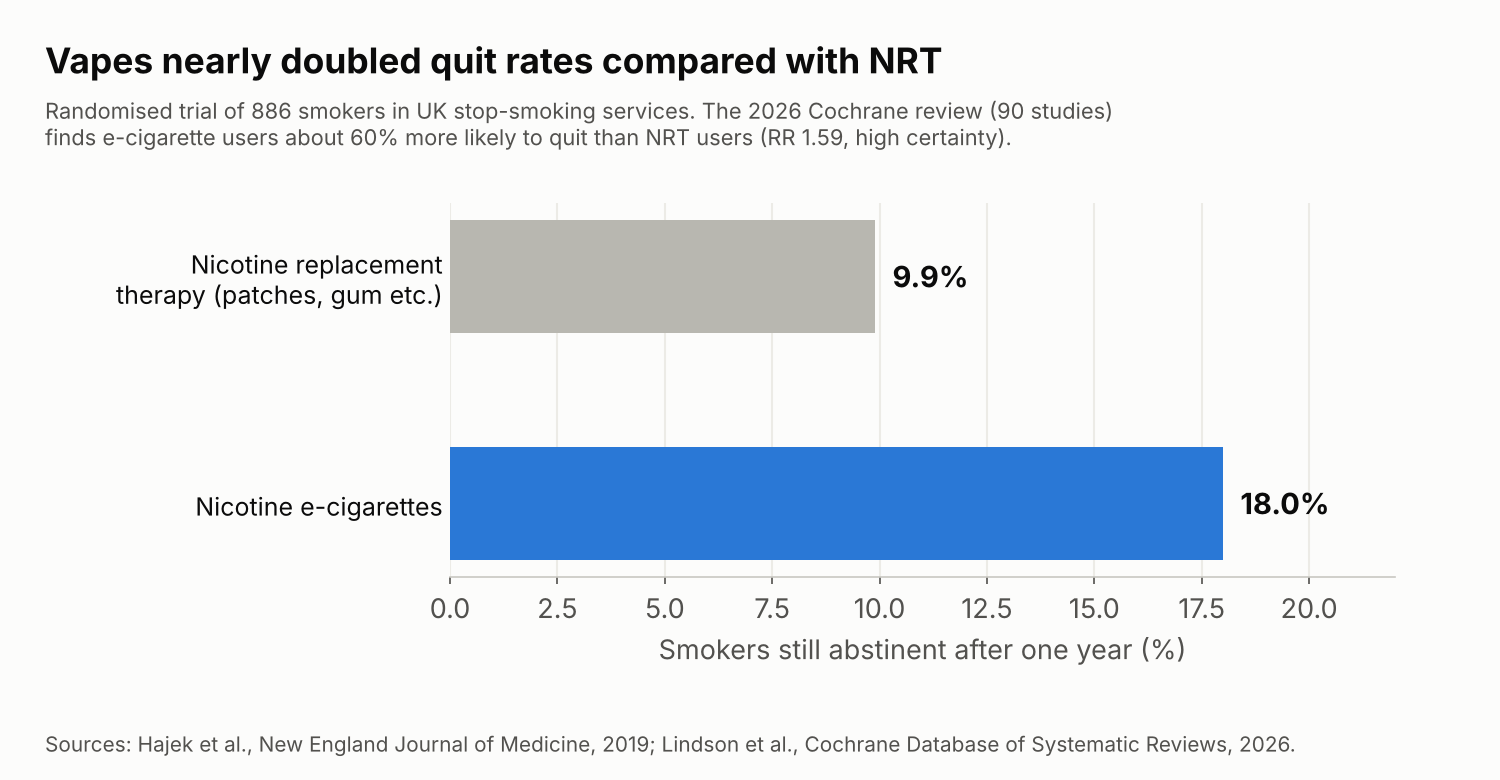
Adequate nicotine delivery may well be why safer products succeed, since a product that leaves a smoker unsatisfied won’t replace cigarettes. Douglas points to two trials. In one, an e-cigarette with cigarette-like nicotine delivery produced higher six-month quit rates than low-nicotine versions. In the other, published in the New England Journal of Medicine, e-cigarettes nearly doubled one-year quit rates compared with NRT.
The latest Cochrane review, published in August 2026 and covering 90 studies with over 29,000 people, found high-certainty evidence that nicotine e-cigarettes help more people quit than NRT. People using them were about 60% more likely to quit. Cochrane reviews are widely regarded as the gold standard of medical evidence.
 Source: Hajek et al., New England Journal of Medicine, 2019; Lindson et al., Cochrane Database of Systematic Reviews, 2026.
In the NEJM trial, 18% of the vaping group stayed off cigarettes for a year, against 9.9% in the NRT group, nearly twice the quit rate. Across all trials in the Cochrane review, vapers were 1.59 times as likely to quit.
The sensible response to high-strength products is therefore regulation: strength limits where evidence supports them, clear labelling and child-resistant packs.
A lifeline for India’s smokeless tobacco users
This is where the column’s framing does the most damage in India.
India’s tobacco problem is mostly a smokeless one. According to the government’s own Global Adult Tobacco Survey (GATS-2), 199.4 million Indian adults use smokeless tobacco (SLT), against 99.5 million who smoke. That’s about three in four of India’s 266.8 million tobacco users. Products like gutka, khaini and zarda are behind most of India’s oral cancers, and India carries about 70% of the world’s SLT burden.
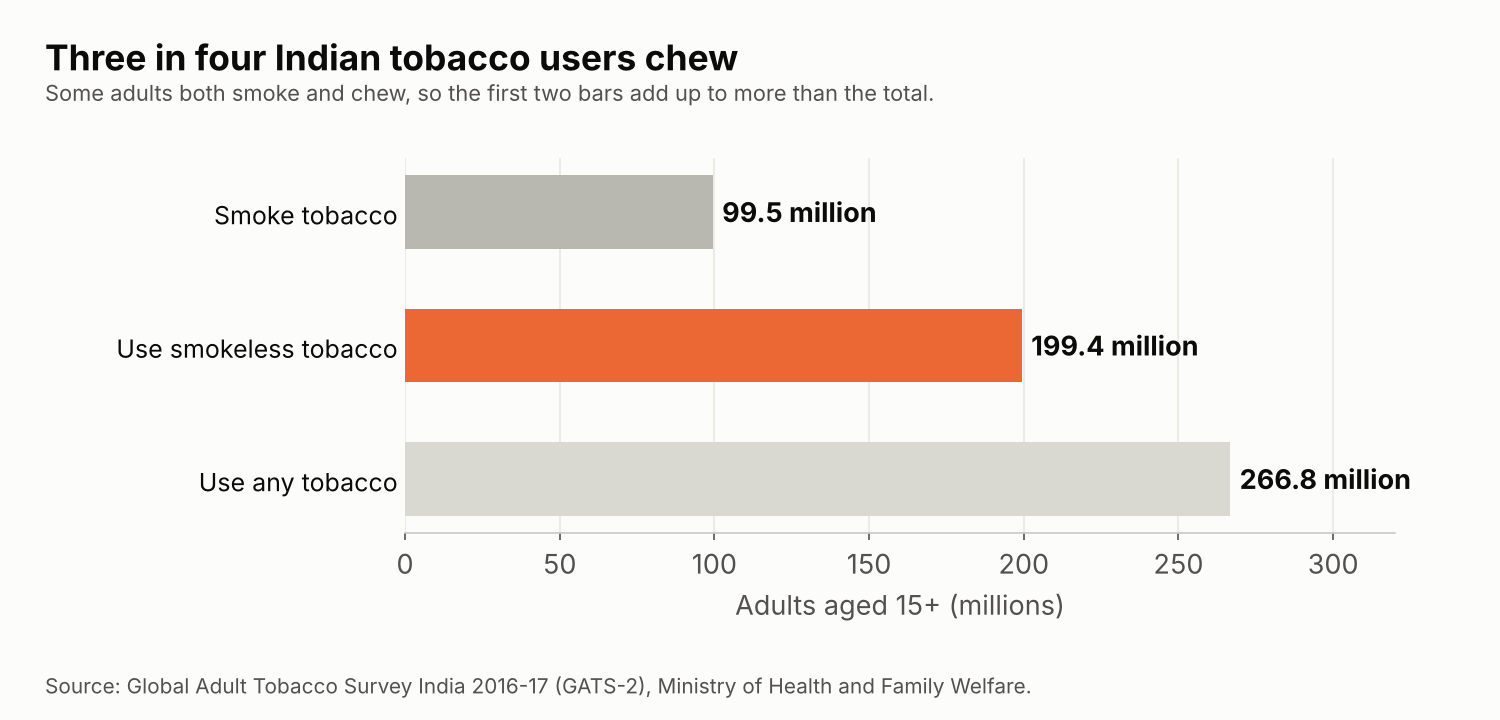 Source: Global Adult Tobacco Survey India 2016-17 (GATS-2), Ministry of Health and Family Welfare.
Nicotine pouches contain no tobacco leaf. This is how they compare with the oral tobacco products Indians use today:
| Product | Tobacco leaf? | Areca nut or slaked lime? | Status in India |
|---|---|---|---|
| Gutka, khaini, zarda | Yes | Often | Widely sold; 51 million adults still bought gutka despite state bans |
| Swedish-style snus | Yes, pasteurised | No | Not available |
| Nicotine pouches | No | No | Treated as unapproved drugs since September 2026 |
| Nicotine gum and lozenges | No | No | Approved medicines |
The evidence on their relative safety is strong:
- In January 2025, the US FDA authorised 20 nicotine pouch products after a lengthy scientific review. It found they contain far lower levels of harmful constituents than cigarettes and most smokeless tobacco, so they pose a lower risk of cancer and other serious conditions.
- A 2025 scoping review in Nicotine & Tobacco Research and chemical analyses published in 2022 and 2023 found pouches expose users to vastly fewer toxicants than cigarettes, with some profiles comparable to NRT.
- The FDA’s own guide to the relative risks of tobacco products places non-combustible products at the lower end of the risk spectrum.
Pakistan offers a preview of what’s possible. About 10 million Pakistanis use SLT, much of it deadly naswar, gutka and paan, and adoption of nicotine pouches has been rapid. AVI’s founder reported in Filter in 2022 that some traditional manufacturers in the region had begun to see pouches as a safer path. By 2025, industry reports described Pakistan as one of the world’s largest pouch markets, driven largely by adults moving away from cigarettes and traditional oral tobacco.
Youth access needs watching, in Pakistan and elsewhere. For adults dependent on khaini and gutka, though, a regulated pouch with a fraction of the toxicants is a lifeline. AVI has argued that India moved to block pouches without weighing this. The health ministry’s September advisory treats them as unapproved drugs, while gutka and khaini remain on sale in every paan shop.
What the UK, New Zealand and Australia show
The column says that public health agencies in the UK, Australia and New Zealand accepted the harm reduction argument and have since woken up to the dangers of youth vaping. Neither part of that holds.
Australia never accepted it. It made nicotine vapes prescription-only in 2021 and later pharmacy-only, a de facto ban on consumer sales. Australia’s own illicit trade commissioner estimates that about 96% of vapes sold there are illegal. Australian smoking has kept falling, to 5.6% daily smokers in 2025, yet many Australians who vape to stay off cigarettes now buy from criminals who check no IDs.
The UK and New Zealand did accept it, and smoking has fallen sharply in both.
- UK adult smoking fell from 20.2% in 2011 to 9.8% in 2025, the lowest on record. Among 18 to 24 year olds, it dropped from 25.7% to 7.2%.
- New Zealand’s daily smoking fell from 16.4% in 2011/12 to 6.8% in 2024/25.
- Sweden, where snus and nicotine pouches are widely used, became the first country in Europe to fall below 5% regular smokers in 2025. It has long had the EU’s lowest rate of lung cancer.
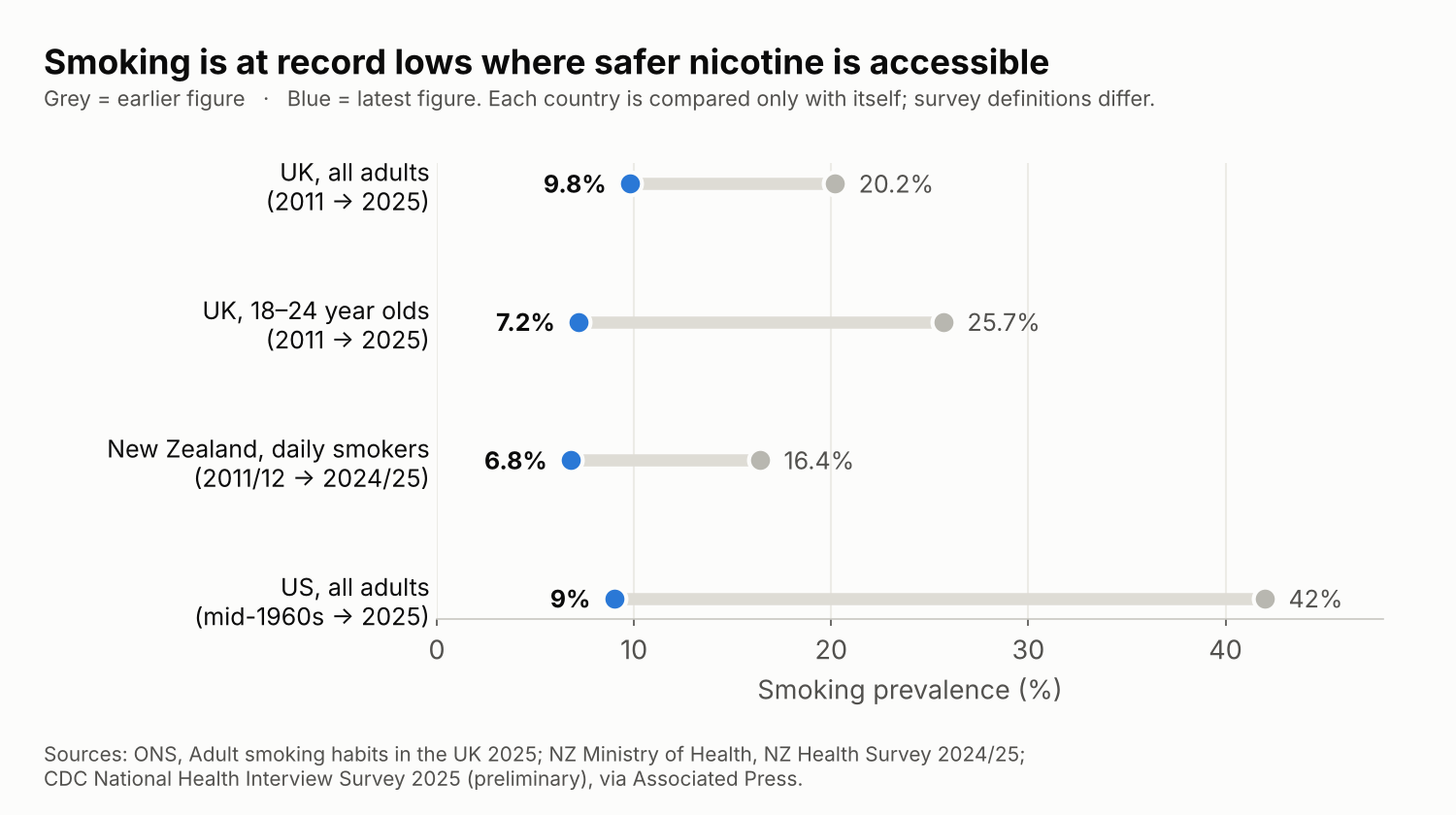 Sources: ONS 2025; NZ Ministry of Health 2024/25; CDC National Health Interview Survey 2025, via Associated Press.
In the US, where vapes and pouches are legally sold, adult smoking fell to 9% in 2025, an all-time low, down from about 42% in the mid-1960s. About 7% of US adults vape, so even counting both, nicotine use is well under half the share who smoked in the 1960s.
The column cites UK data showing more than 10 lakh people who have never smoked have taken up vaping. The ONS figure is 1.1 million in Great Britain, or 2.9% of never-smokers, and it deserves monitoring. Of Britain’s 5.4 million vapers, though, about 4.3 million, or 80%, are current or former smokers. Most vaping in Britain still involves people moving away from cigarettes.
These countries are now tightening rules on flavours, marketing and sales to minors, which is regulation working as intended. Keeping products away from children and keeping them available to adults who smoke are compatible goals. In the US, where vapes are legal for adults over 21, tighter enforcement and education cut youth vaping from 20% of middle and high school students in 2019 to 5.2% in 2025, a fall of 74%, even as adult smoking reached a record low. Only a legal, regulated market can deliver both.
Palau’s plan would protect cigarettes and harm smokers
The column closes by urging India to support Palau’s initiative at the UN, which it describes as a petition for a scientific study of the health harms of nicotine.
That understates what Palau is doing. On 10 June 2026, Palau formally notified the UN Secretary-General under the 1971 Convention on Psychotropic Substances, the treaty that governs drugs such as LSD and amphetamines. The notification triggers a WHO review that could lead to nicotine being placed under international drug control. WHO’s Expert Committee on Drug Dependence took up the matter at its October meeting.
Tobacco policy expert Clive Bates, a former director of Action on Smoking and Health in the UK, has called it “the worst idea in the history of tobacco control”. His main points:
- It would target the safer products and leave cigarettes alone. The 1971 Convention covers isolated chemicals rather than plants. In practice it would apply to extracted or synthetic nicotine in vapes and pouches, while cigarettes, bidis and gutka remain legal.
- It would hand markets to criminals. Scheduling would also bring in the 1988 treaty on illicit trafficking. Bates notes that Australia’s medical-only model has already ceded about 96% of its vape market to illegal sellers.
- It ignores how people use nicotine. Many adults use nicotine much as others use caffeine. Confining safer products to a medical-only model means most users won’t follow it.
- It lacks transparency. Bates questions who is funding and driving the initiative, given Palau’s population of about 18,000. Filter has reported on the outside groups involved.
Palau’s own record raises further questions. According to the Tobacco Atlas, 42.4% of Palauan adults use smokeless tobacco, a category that includes gutka, and the Atlas describes tobacco use there as an epidemic. A government facing that problem at home has chosen to campaign abroad against the products that could help its own SLT users quit.
There’s a wider question here for India. Much of the global campaign against safer nicotine is funded by Bloomberg Philanthropies, which has spent $160 million pressing for flavoured vape bans in the US alone. In India, the home ministry’s intelligence wing flagged in 2016 that Bloomberg money reaching local NGOs through the Campaign for Tobacco-Free Kids was being used for lobbying. A year later the Public Health Foundation of India, which Prof Reddy founded and led, lost its foreign funding licence over allegations that it used foreign funds to lobby on tobacco control. PHFI denied the charge, and the licence was later restored.
We raise this without questioning anyone’s sincerity. Prof Reddy, now Chancellor of the PHFI University of Public Health Sciences, has a long record of public service. But India’s tobacco policy should be shaped by Indian evidence and the needs of Indian tobacco users. When positions that suit well-funded foreign campaigns, such as backing Palau, are presented as settled science, policymakers are right to ask whose priorities they serve.
India’s own experience shows where prohibition leads. Seven years after the vape ban, AVI’s earlier analysis of IMARC data found India’s illegal vape market growing almost as fast as the legal global one, while India’s legal cigarette market is growing faster still.
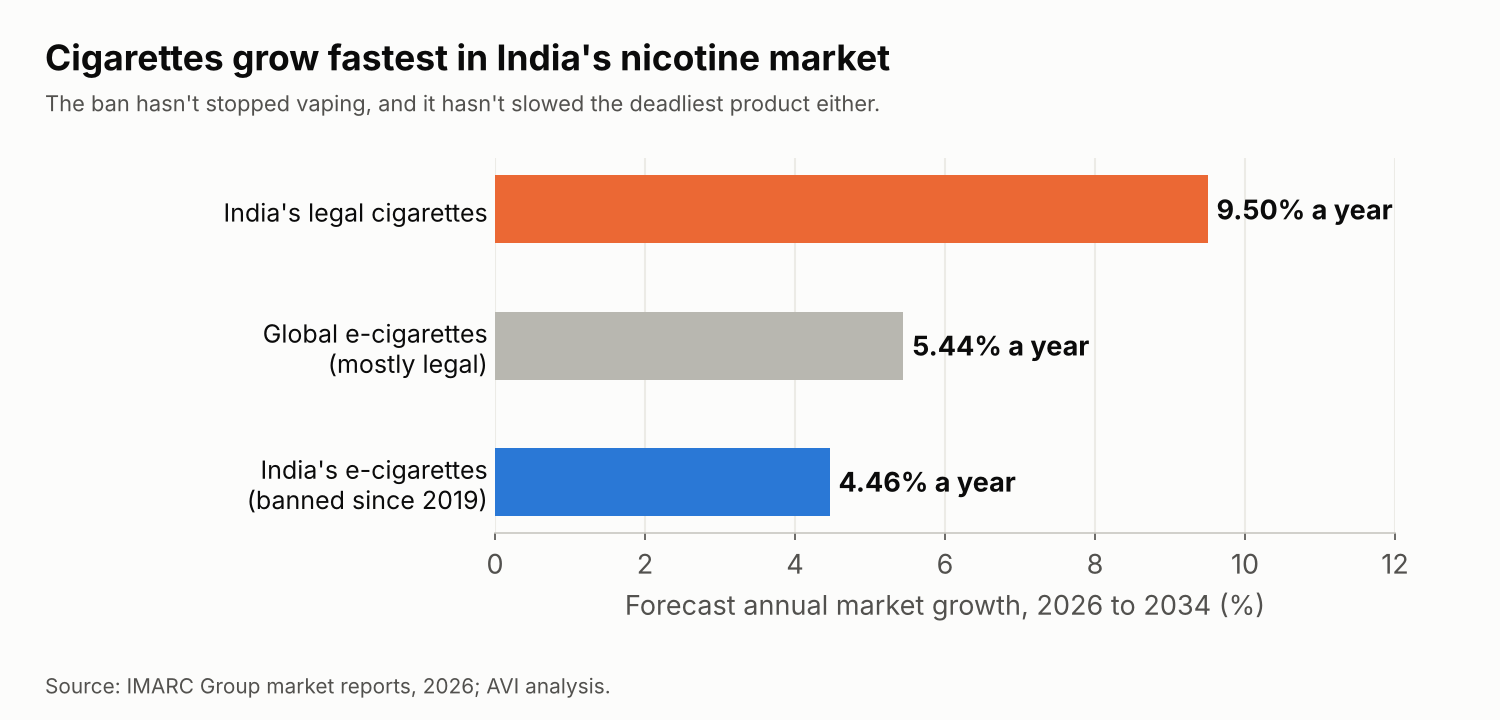 Source: IMARC Group market reports for India cigarettes, global e-cigarettes and India e-cigarettes, 2026.
India’s 267 million tobacco users need safer options regulated at home. A global ban would remove them altogether.
What India should do instead of prohibition
Prof Reddy is right that kicking the butt alone won’t do it. Three in four Indian tobacco users consume smokeless products, and any serious policy has to reach them as well as smokers. The answer is to target the harm: replace prohibition with licensed, age-checked sale of safer nicotine products, hold those products to clear standards, tax them by risk, tell users the truth about relative risk and keep India out of Palau’s campaign. Each step is set out below.
- Regulate safer nicotine products for adults. Licensed retailers, strict age checks and real penalties for selling to minors would replace a black market that checks no IDs. Our analysis of the vape ban shows prohibition has handed a ₹22,000 crore trade to unlicensed sellers.
- Set product standards. Rules on nicotine strength, ingredients, battery safety and labelling would give consumers products of known quality. Child-resistant packaging should be mandatory for every nicotine product, including pouches and e-liquids.
- Bring pouches into a legal framework. Treating tobacco-free pouches as unapproved drugs leaves gutka and khaini as the only legal oral nicotine products for most Indians. A regulated category for pouches would give India’s 199 million SLT users a far less toxic option.
- Tax by risk. Vapes should carry the standard 18% GST, with at most a small excise, and pouches should be taxed well below gutka and cigarettes. Keeping safer products clearly cheaper gives smokers and SLT users a reason to switch, while legal sales raise revenue the exchequer currently loses.
- Earmark the revenue. A share of that tax should fund youth prevention campaigns and quit support aimed at older smokers and SLT users, who stand to gain most from switching.
- Communicate relative risk accurately. Official messaging that treats all nicotine products as equally harmful keeps people on the deadliest ones. Clear public information, of the kind the UK and New Zealand provide, would help users make informed choices.
- Oppose Palau’s scheduling bid. India should make clear at the UN Commission on Narcotic Drugs that it won’t support placing nicotine under drug control. Such a move would leave cigarettes, bidis and gutka legal while outlawing the alternatives.
Nicotine is addictive, and nobody disputes that. But it is tobacco smoke and smokeless tobacco that kill 1.35 million Indians a year. Policy should target those products and give their users a safer way out.
Nicotine and harm reduction: quick answers
Is nicotine a carcinogen?
No. The International Agency for Research on Cancer, part of WHO, has never classified nicotine as a carcinogen. Tobacco smoke and smokeless tobacco are classified as Group 1 carcinogens.
Has WHO said nicotine is as addictive as heroin?
We found no WHO assessment saying so. The comparison comes from a 1988 US Surgeon General report on tobacco addiction. Unlike heroin and cocaine, nicotine isn’t controlled under any UN drug treaty.
Is long-term NRT use safe?
India’s Ministry of Health manual says harmful effects of long-term nicotine gum use are unlikely. The UK’s medicines regulator found no sign that long-term NRT use is linked to heart disease or other serious harm.
Do vapes help people quit smoking?
Yes. The August 2026 Cochrane review found high-certainty evidence that nicotine e-cigarettes help more people quit than nicotine replacement therapy, by about 60%.
Are nicotine pouches safer than smokeless tobacco?
Yes, by a wide margin. The US FDA found authorised pouches have far lower levels of harmful constituents than cigarettes and most smokeless tobacco, and they contain no tobacco leaf.
What is Palau's nicotine initiative?
Palau has asked the UN to consider placing nicotine under the 1971 Convention on Psychotropic Substances. Critics say this would ban safer products like vapes and pouches while cigarettes remain legal.